
Case study
Nutripure
Technical & international SEO · Shopify Markets (ES / IT)
Dec 2025 – Feb 2026 · In partnership with EXPERAISE
Measured outcomes and deliverables
+34%
GSC impressions
8 weeks vs the prior 8 · GSC source · engagement Dec 2025–Feb 2026
ES ↔ IT
Reciprocal hreflang
checked in source · x-default on the hub page
+2,700
Images compressed
harmonized ALT · image SEO
4
Templates validated
Rich Results Test · JSON-LD
Engagement at a glance
Context
A sports nutrition brand on Shopify, with an international rollout focused on the Spanish and Italian markets.
Initial problem
International and technical signals needed to be made reliable: market URLs, hreflang, crawl, structured data, headings and media weight.
Starting data
Technical state observed before correction in source code, Search Console and Google validation tools. No revenue figure was used as a baseline.
Exact role
Shopify technical implementation across Markets, hreflang, robots, JSON-LD, heading hierarchy, performance, images, QA and documentation.
Out of scope
Editorial production, paid acquisition and revenue attribution. The engagement does not claim a direct revenue gain.
Duration
December 2025 to February 2026, delivered in association with EXPERAISE.
Measurement period
Eight weeks compared with the prior eight weeks for the change in GSC impressions.
Sources
Google Search Console, template source code, Google Rich Results Test and documented QA checks.
Case study
Context & problem
Nutripure is a nutrition brand on Shopify with international scope: the engagement focused on Spain and Italy through Shopify Markets while keeping a coherent hub. The goal was not only “classic” SEO-we had to stabilise the international layer (paths, languages, duplication signals) so Google clearly knows which URL to serve for which country and language, and to reduce crawl waste from parasitic or unnecessarily indexable URL variants.
Typical multi-market issues showed up: noise from filter / parameter URLs, potential mismatches between ES and IT, and the need for clean, reciprocal hreflang rules with an explicit x-default on the “hub” homepage. In parallel, the theme and apps loaded JavaScript sub-optimally on some pages, and the image library was very large (thousands of product and marketing assets)-a major lever for image SEO and Core Web Vitals.
The scope included: Google Search Console (post-release checks, indexation, international and performance), robots.txt (crawl focus, blocking low-value patterns), JSON-LD schema (BreadcrumbList + FAQPage aligned with visible content to avoid quality mismatch), H1–Hn semantics on key templates, and a media pass (compression, formats, consistent ALT text).
Key decisions
Make every international signal consistent with the storefront.
The work was not an isolated SEO layer. Each decision had to remain compatible with Shopify Markets, existing templates and future theme releases.
- 01
Map before changing
ES and IT URLs, canonicals and hreflang relationships were mapped before implementation to avoid contradictory rules.
- 02
Reduce crawl noise
Filters, parameters and low-value variants were addressed so crawling could focus on genuinely strategic pages.
- 03
Document validation
Checks in source code, Rich Results and Search Console were recorded so future releases remain verifiable.
Storefront UI · Spanish market (ES)
Analysed capture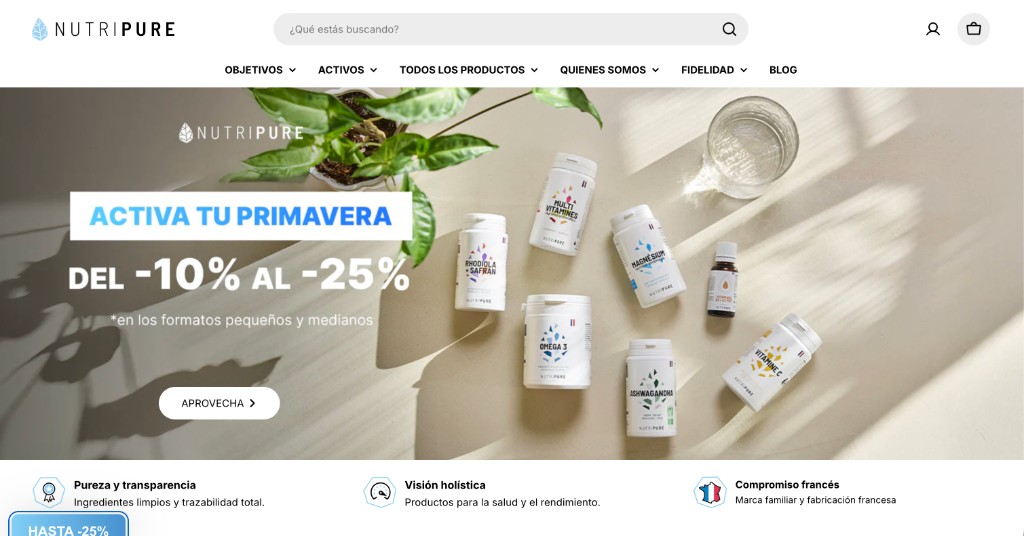
- 01
Visible Spanish market
Localised navigation and content materialise the ES version that technical signals must identify without ambiguity.
- 02
Priority content
The hero and immediately visible blocks stay central to heading, image and performance checks.
- 03
Associated technical layer
Canonical, hreflang, JSON-LD and crawl rules are verified behind the interface, template by template.
Work completed (detail)
Work completed (detail)
- Shopify Markets / languages: URL mapping by market, reduced parasitic URLs (filters, parameters, nav variants) and clearer indexation rules to limit international noise.
- Hreflang: reciprocal ES ↔ IT pairs, x-default on the hub homepage, checked against canonicals and market redirects to avoid conflicts.
- JSON-LD structured data: BreadcrumbList and FAQPage implemented or fixed where content allowed, with visible vs marked-up content alignment to avoid quality issues or “structured spam”.
- robots.txt: crawl rules tuned (blocking unhelpful patterns, filter parameters, low-value duplicate paths) and consistent with priority templates to crawl.
- Heading semantics: collection, product and editorial templates updated for a single H1 and coherent sub-levels for semantic indexing, engines and accessibility.
- Front performance (LCP and loading): defer and ordering for non-critical scripts, less main-thread work on load, targeted pass on collection pages (listings and facets are heavy).
- Media: 2,700+ images compressed and optimised, ALT text standardised (descriptive, not keyword-stuffed), priority for above-the-fold visuals on key journeys.
- Search Console: indexation and international coverage, Core Web Vitals monitoring, post-deploy validation on representative URLs per template.
- Decision log (canonicals, hreflang, robots blocks) so future theme or app releases do not start from zero each time.
Deliverables
Deliverables
- Full documentation (Drive): context, URL/market map, hreflang rules, robots, schema, performance checklist.
- Operational handover: maintenance roadmap, theme/app watch points, stack references.
- QA checklist: view-source review (JSON-LD and headings), Rich Results / schema tests, Search Console checks (coverage, international, CWV) on a URL sample.
- Handover tips: how to quickly verify after a deploy (hreflang regression, scripts, new template indexation).
Outcome & how to read it
On international SEO, the aim is a more stable base: less ambiguity for Google between markets, explicit hreflang, and robots that favour useful crawl over duplicated URL volume.
On performance, catalog and product journeys improve (better script strategy, lighter media), which shows in Web Vitals and image SEO (ALT and file weight). Gains are measured mainly on indexation stability, signal clarity, and the ability to iterate (new market or template) without immediate rework.
Inside the project
The real challenge: aligning Markets, the theme and search engines.
Nutripure’s challenge is international. A local fix is not enough when the Spanish and Italian versions send conflicting signals.
- URLs & languages
- Check the rendered URL, canonical and ES/IT alternates together. A translated storefront does not by itself prove reciprocal hreflang.
- Templates & structured data
- Review product, collection and editorial templates in their rendered HTML. Structured data must describe the visible page, not an assumed catalog state.
- Crawling & maintenance
- Document robots rules and parameters to monitor. Theme or app updates can reintroduce inconsistencies that were previously corrected.
These points explain the validation method for the scope described above. They do not introduce new performance claims.
Dossier reviewed ·
Related recommendation
LinkedIn recommendation“On the NUTRIPURE engagement, Teo and I worked on technical SEO, particularly the international Shopify configuration with hreflang and Markets. He is an excellent developer whom I recommend without hesitation.”
Charly Cabéçadas
Shopify SEO and GEO consultant · collaboration on the Nutripure engagement
Related engagement
Does your challenge look like Nutripure’s?
Shopify SEO/GEO support covers the technical foundation, Markets, indexation and validation checks with a documented scope.